
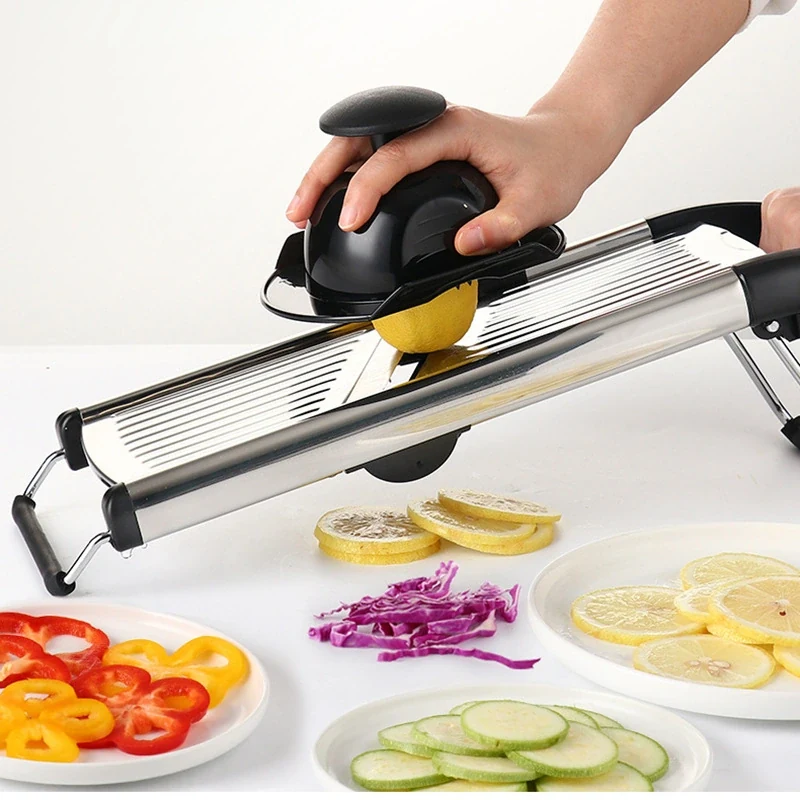
Short answer: ask the supplier to confirm whether the quoted HK12-4-80 is the mandoline-style tool pictured, request the exact sample and included guard, and check that the guard holds the food while keeping fingers away from the blade. Verify actual cutting settings, base stability, cleaning instructions and component materials on that sample. Then approve a documented pack and a destination-specific quotation; do not infer a safety certification from the photo.
Buyer concern is grounded in the current Hehui HK12-4-80 product page, which notes that the supplier headline calls it a “drum grater” while the image shows a mandoline-style slicer. The page lists a stainless-steel blade and shows a guard, but asks buyers to verify the body material, cutting settings and current configuration. A 2026 Food & Wine test of other mandoline models highlights guard usability, nonslip support, cut consistency and cleaning as useful evaluation questions; those tests were not conducted on HK12-4-80.
1. Confirm what tool and accessories the offer includes
Ask the supplier for a dated photo of the full quoted set: slicer, guard, stand or support if applicable, blade options, protective cover if any, instructions and retail packaging. Tie the photo and component list to the model and sample you approve. A pictured guard is a prompt for confirmation—not proof that every configuration ships with it.
2. Trial the guard, cutting control and stability
With an approved sample and its instructions, compare how the guard holds different suitable ingredients and how the base or support sits on the intended surface. Record measured slice thickness and cut consistency for each confirmed setting; do not quote a preset count or precision tolerance absent from the supplier's written specification. Keep hands clear of the exposed blade and follow the product's instructions during the trial. Request the supplier's warnings and safe-storage guidance for the exact configuration.
3. Review cleaning without promising dishwasher compatibility
Check whether food residue collects near the blade, adjustment mechanism or guard, and whether the approved instructions explain safe cleaning and storage. Ask whether any parts are removable and how they should be handled. Do not assume that stainless-steel blade wording means the entire body is stainless steel, or that the model is dishwasher safe.
4. Request market-specific material evidence
The European Commission food-contact materials overview identifies kitchenware as potentially food-contact articles and outlines the general EU framework and material-specific requirements. For an EU-bound version, ask your importer or compliance adviser which component-level evidence is appropriate for the actual blade, guard and food-contact surfaces. Match each report to its tested sample and scope; do not substitute a company social-audit summary for a product material report.
5. Lock the pack, MOQ and freight assumptions in writing
The current product page cites a supplier listing from three pieces; it does not promise that minimum for every custom variant or make it an active quote. Request separate terms for the stock item and any logo, manual or retail-box changes. Confirm how the blade and guard are immobilized in the retail box, master-carton quantity and dimensions, packed weight, destination and shipping terms. Approval should cover the exact sample, component list and packaging version to be supplied.
Buyer FAQs
Is HK12-4-80 a rotary cheese grater?
The Hehui product page flags a headline-versus-photo mismatch and describes the pictured tool as a mandoline-style slicer. Ask for a written mechanism and model confirmation before purchase.
Does the guard in the photo prove every unit includes one?
No. Ask for a component list and a current sample of the exact quoted retail set, then verify that the guard fits and works as described.
Can buyers assume it has multiple slice settings?
No. Verify settings or included inserts by sampling and in a written specification; the current page does not establish a particular count or tolerance.
Does this page certify the product as safe for every market?
No. It provides procurement questions, not a test certificate. Confirm market-specific requirements and component-linked evidence with your importer or adviser.
What should I include in an initial inquiry?
Send target quantity, intended destination, required cutting functions, desired guard and packaging contents, private-label needs and the documents you need. Request a current sample and a product-plus-shipping quotation.
Request the HK12-4-80 sample and quote
Ask Hehui for the exact pictured/quoted variant, included guard, cutting-mode and material specifications, current stock and customized minimums, retail packing and freight to your destination.
Request a product and shipping quote ↗Sources: Hehui Kitchen, HK12-4-80 product page (supplier model, photo and qualifications); Food & Wine, mandoline evaluation, updated March 2026 (general buyer considerations from other models, not a test of Hehui); European Commission, Food Contact Materials (general regulatory context). No unverified safety certification, test result, customer review, exact cutting tolerance or guaranteed MOQ is claimed for HK12-4-80.